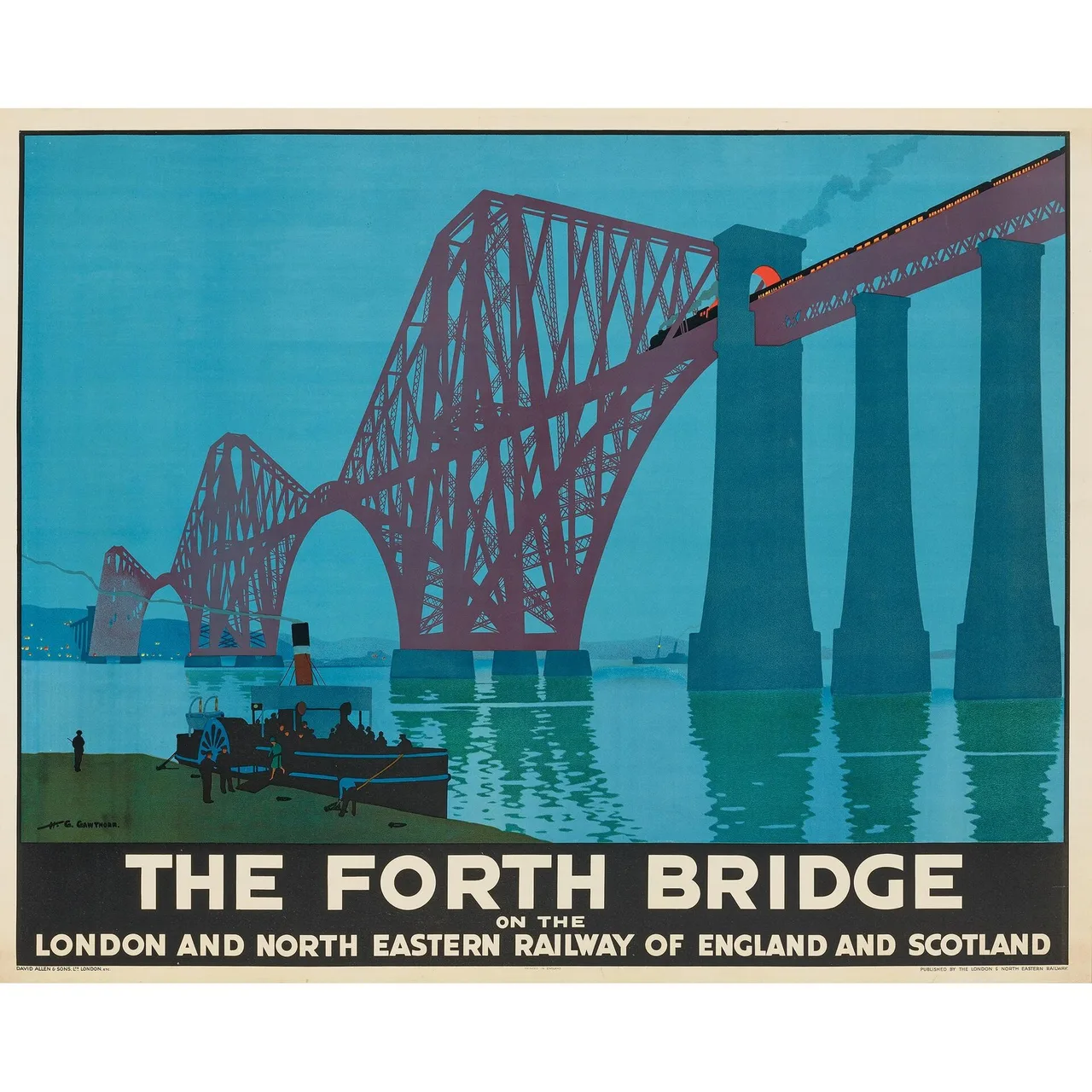
What a vintage railway poster was
Start with the object rather than the style. A railway poster was a printed advertisement. A company paid for it, an artist drew it, a printer ran off thousands of copies, and they were pasted up in booking halls and along platforms to sell a destination or a service. It wasn't made to be art. It became art later, once the companies had gone and the paper turned out to be the thing worth keeping.
A great deal of it was kept. Search the national railway collection online today and you’ll find 8,354 records filed as railway posters, notices and handbills. That is a better starting point than any top-ten list, because you get the ordinary posters alongside the famous ones, and the everyday posters teach you more about the conventions than the famous few.
The Act that made the poster era possible
Britain's railways ran as dozens of separate companies until Parliament rearranged them. The Railways Act 1921 puts it flatly at section 1(1): "railways shall be formed into groups in accordance with the provisions of this Act, and the principal railway companies in each group shall be amalgamated" (legislation.gov.uk, read 3 September 2026).
That is a commercial fact before it's a design one. A small number of very large companies, each holding a whole region and each with an advertising budget to fill it, is the condition the poster era grew in.
How they were printed, and why it shows
Lithography reached the railways long before the poster era did. The same collection holds a print catalogued as "Cornwall Railway. Lithograph in black", dated 1859, object number 1943-279 (collection, read 3 September 2026). By the time the grouped companies started advertising, the process had decades of colour work behind it.
Browse a page or two of that catalogue and the family resemblance jumps out, and it sits in the printing, not the subject. Flat blocks of colour with hard edges between them. A small palette. Lettering big enough to read from the far side of a platform. Shapes simplified until they land at a glance, because the audience was somebody walking past with a suitcase and about four seconds to spare.
That is a description of what the collection shows, not a rule anybody published. The style was never written down in a manual. It came out of what the presses did well and what a hurrying passenger could take in.
From handbill to the Jolly Fisherman
The first railway posters weren’t pictures at all. The National Railway Museum’s history of the poster describes plain letterpress handbills and notices, set from standard printing blocks like the stagecoach bills before them. Colour posters got going from the 1870s, but the museum says the railways didn’t make real use of artists until 1905, when the London & North Western Railway commissioned Norman Wilkinson to paint landscapes for a new kind of poster.
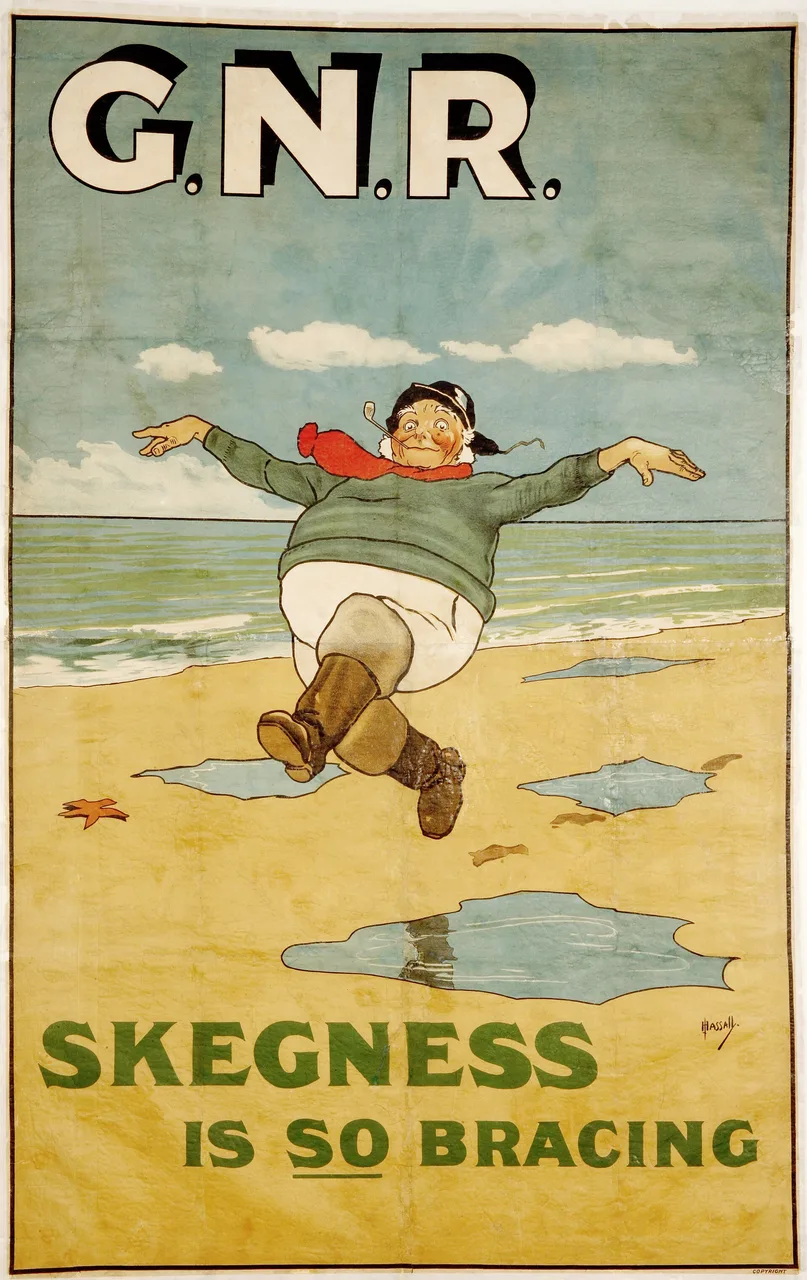
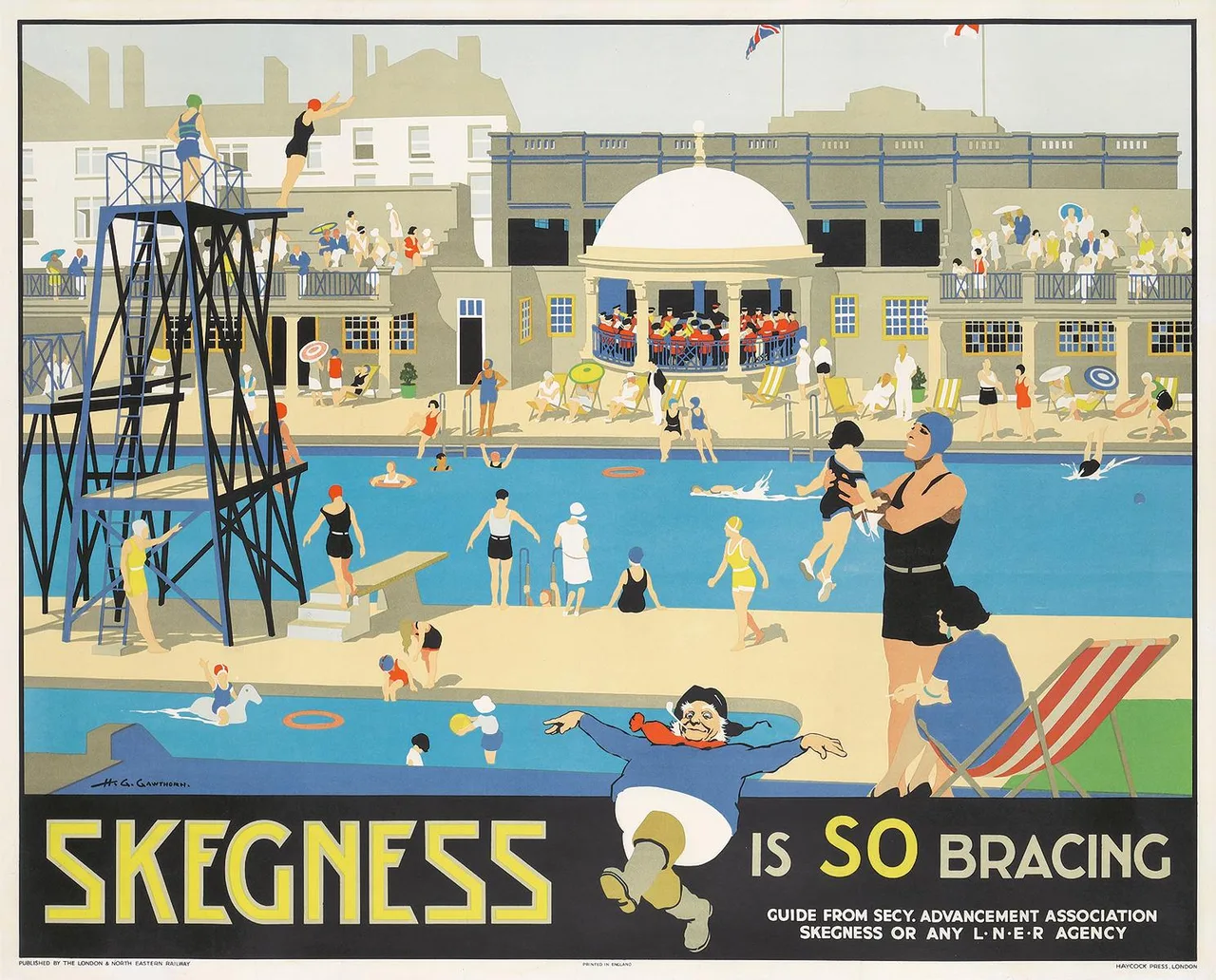
Three years later came the Great Northern’s best-known poster. John Hassall’s Skegness is So Bracing first appeared in 1908 for the Great Northern Railway, with the Jolly Fisherman skipping along the beach. Skegness is a good example of what these posters were for. The museum notes that in 1871 the town had fewer than 500 people; the railway arrived two years later, and by 1907 it was drawing 300,000 visitors a year, mostly from the industrial towns of the East Midlands and Yorkshire. The fisherman outlived his railway, too. After 1923 the LNER kept him, and Henry George Gawthorn dropped him into a crowded bathing pool scene for a poster of his own (the National Railway Museum’s history of the British railway poster, read 22 October 2026).
The two sizes every collector knows
Most railway posters were printed in two standard sizes. Double royal, about 102 by 64cm, stands upright and went on platform boards. Quad royal, about 102 by 128cm, is twice as wide and went on the big hoardings. Specialist auctioneers Onslows put an attractive original at £300 and up, and the best-loved designs at £2,000 to £5,000. Looking at one for sale? Check the size first, then the railway company’s name and the printer’s line along the bottom edge (Onslows, collecting travel posters, read 22 October 2026).
Why the look outlived the railways that paid for it
The companies were reorganised, then reorganised again, and the posters carried on being good. They get reprinted, pastiched and put on tea towels, and the visual language has outlasted every organisation that ever commissioned one.
What we can say is why the style keeps working on a wall. It was designed to be legible from a distance and to hold together as one shape, which is exactly what a picture needs to do above a sofa. A photograph is often the opposite: detailed, evenly lit and best examined close up. That difference is the whole reason for restyling one.
Old railway posters, and the new prints we make instead
Old railway posters were drawn by working commercial artists and printed in quantity, and the national collection still has plenty of the famous ones. Tom Purvis (1888 to 1959) is in the catalogue as a poster artist who designed for the LNER; his East Coast Joys, Sun-bathing, from 1931, is a good one to look up. The LNER guide explains why his posters hardly ever show a train (Science Museum Group, railway posters; Skegness is So Bracing; Tom Purvis; East Coast Joys, all read 21 October 2026).
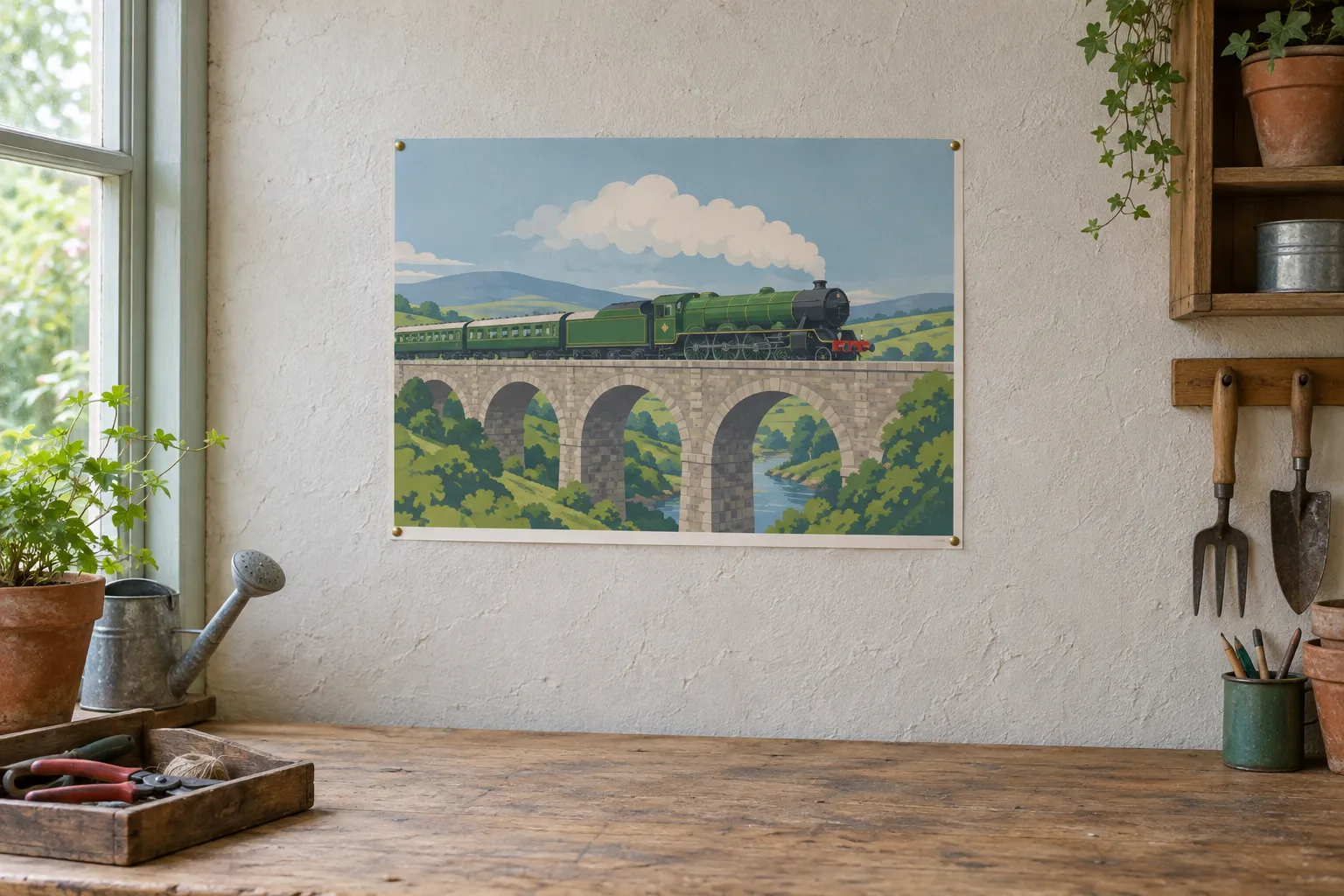
We don't sell old railway posters or period originals. We print new work in that spirit, from a photograph you took. If you're after a surviving original, railway posters covers where the survivors are kept. There is no text field on this site. You upload a picture, choose a studio style, and the studio restyles it. The vintage poster treatment is one of five the studio offers, and the next stage covers the lot properly.
We never borrow anybody's marks. No company names, no crests or roundels, no nameplates, no numbers lifted off a real locomotive, and no reproduction of an existing poster. If a livery shows up in your print it is because it was in your photograph and stayed there.
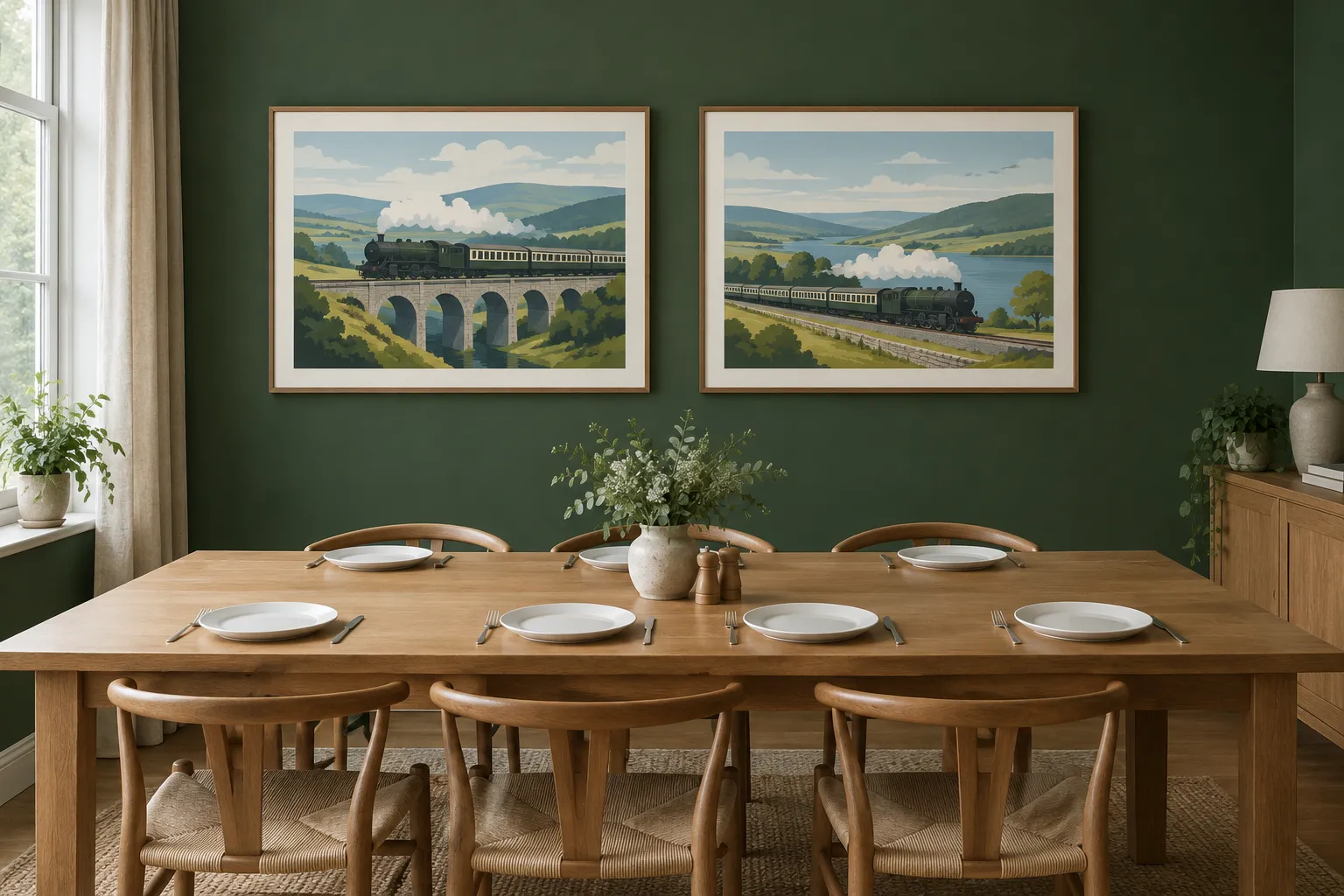
What a poster-style print comes out on
The style suits paper more than anything else, and the larger the better: a poster look designed to be read across a booking hall does not want to be small. Framed, on canvas, or as a bare sheet all work, though every one of those has its own size range and its own limits. The size guide lists what we make and puts each option next to real furniture, and preparing the photograph covers whether your file can reach the top of that range.
This page is the whole of the first stage, so if you have read it you have read the tradition. Reading, not buying? The gift stage is the one that argues about people instead of formats, and nothing here has to end at a checkout. If you are buying for someone, train gifts sorts the options by person.